Tuesday, December 5, 2006
Definitely a Carolina wren. Definitely.
Thanks to Bill of the Birds' latest post on the Carolina wrens at Indigo Hill, I am now certain that the bird I thought was a Carolina wren was indeed a Carolina wren. I'm learning!

Monday, December 4, 2006
Take Action: Stop Misleading Abortion Bill
Lame duck House will vote Wednesday on another abortion roadblock: this deceptive bill will put women's health at risk and add one more barrier to abortion access.
The House of Representatives will be voting this Wednesday under "suspension of the rules" on a deceptive measure that the authors have misnamed the "Unborn Child Pain Awareness Act" H.R. 6099. In fact, it is an attempt to intimidate women into request expensive and unnecessary fetal anesthesia, which could then place the procedure financially outside their reach. We must act quickly to soundly DEFEAT this legislation – which needs a two-thirds vote of the 435-member House to prevail!
Take Action NOW!
The legislation would force physicians to provide misleading and manipulative information to women seeking abortions at 20 weeks or more after fertilization. The bill calls for doctors to give patients a brochure with language scripted by anti-abortion legislators, not physicians.
Despite the inability to support such a claim medically, the text of this brochure tells each woman that her "unborn child" will experience pain while "being killed in an abortion." The doctor would then be required to offer the woman anesthesia or another "pain reducing drug" to be administered directly to the fetus.
Beyond the direct impact on women seeking abortions and the requirements placed on doctors, the legislation would ultimately reduce women's access to abortion: How many doctors have the resources, training and insurance coverage to administer anesthesia to a fetus in their office or clinic? How much extra will the anesthesia cost? And how can patients say no when the pressure is so emotionally intense? Many women seeking an abortion are already in economic straits and will be unable to afford the additional cost of hard-sell fetal anesthesia.
Please take action today by calling or emailing your representative. On such short notice, phone calls are often a better way to reach your representative's office to leave a message (be sure to tell them that you live in the district and give your address to prove it!) We've provided a suggested script for your call; get the script and your representative's phone number. Or send an email to your representative.
Get more information on this legislation
Take Action NOW!
The House of Representatives will be voting this Wednesday under "suspension of the rules" on a deceptive measure that the authors have misnamed the "Unborn Child Pain Awareness Act" H.R. 6099. In fact, it is an attempt to intimidate women into request expensive and unnecessary fetal anesthesia, which could then place the procedure financially outside their reach. We must act quickly to soundly DEFEAT this legislation – which needs a two-thirds vote of the 435-member House to prevail!
The legislation would force physicians to provide misleading and manipulative information to women seeking abortions at 20 weeks or more after fertilization. The bill calls for doctors to give patients a brochure with language scripted by anti-abortion legislators, not physicians.
Despite the inability to support such a claim medically, the text of this brochure tells each woman that her "unborn child" will experience pain while "being killed in an abortion." The doctor would then be required to offer the woman anesthesia or another "pain reducing drug" to be administered directly to the fetus.
Beyond the direct impact on women seeking abortions and the requirements placed on doctors, the legislation would ultimately reduce women's access to abortion: How many doctors have the resources, training and insurance coverage to administer anesthesia to a fetus in their office or clinic? How much extra will the anesthesia cost? And how can patients say no when the pressure is so emotionally intense? Many women seeking an abortion are already in economic straits and will be unable to afford the additional cost of hard-sell fetal anesthesia.
Please take action today by calling or emailing your representative. On such short notice, phone calls are often a better way to reach your representative's office to leave a message (be sure to tell them that you live in the district and give your address to prove it!) We've provided a suggested script for your call; get the script and your representative's phone number. Or send an email to your representative.
Sunday, December 3, 2006
Two lifebirds in one day!
Today, the sun was blazing for the first time in a while, so I grabbed the Condor and the camera and set up a little station for myself. I sat in an Adirondack chair and put a little side table in front of me, on which I set the Condor on its table-top tripod.
The birds, probably just as happy as I was to see the sun, cooperated and took their places at the feeding stations. I set up to watch the platform feeder on the back fence with the scope, later moving it to watch the hanging feeder. I watched the suet feeder with my eyes and my binocs.
My first shot through the scope:
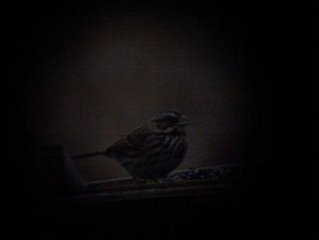 No, it wasn't night time. This is just that bad. There's a little sparrow in that blackness, sitting on the platform feeder.
Clearly, some adjustment was necessary.
I backed off the zoom on the scope (it goes 20-60X), backed off the zoom on the camera (the Nikon CP4800), and repositioned. Mr. Cardinal allowed this photograph of his somewhat moult-y form:
 Does this fluff make me look fat?
Certainly an improvement, but the focus still wasn't too good. Also, vignetting was a big problem:
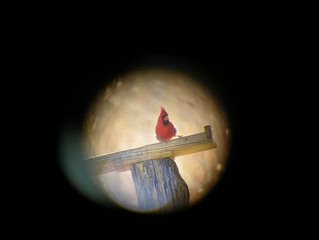 After some experimentation, I found that zooming the scope only a little bit cut the vignetting almost completely for my eye, but it only improved it somewhat for the camera. I think the problem lies in the camera lens, which is set back in the camera body. When I zoom, the barrel comes way out, and it seems the lens is even farther from the scope's eyepiece than before. So the camera was not zoomed at all for the rest of the photos; the scope was mainly on about 25-30X zoom. Further, I have no adapter, so I'm just holding the camera's lens to the scope with my left hand. Conditions were full sun, somewhat backlighting the subjects from directly behind and then slightly to the right but still behind as the sun travelled its in low winter arc across the sky.
I then heard a strange call and was stunned to see my first red-bellied woodpecker! I got a lot of blurry shots, but this is a fairly clear one:
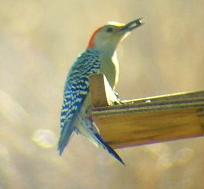
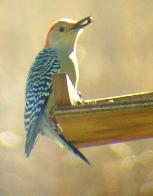 Of course at first, I was so freaked out by this lifebird that I took a video, but I don't know how to load those onto Blogger and I dare not just try loading it like a photo on my dial-up connection! Let's move on:
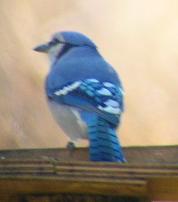 I love the rumps of bluejays--so many shades of blue all together. Bluejays are mean and they tend to hog the feeder, but they're beautiful. At one point when I was just watching through the scope, the red-bellied was sitting on the platform and a jay tried to land, but the red-bellied opened his mouth and shooed the jay away--I didn't really hear a sound from the open mouth, but it was a clear "Hey, wait your turn!"
The infamous American goldfinch in winter plumage showed up and offered this pose:
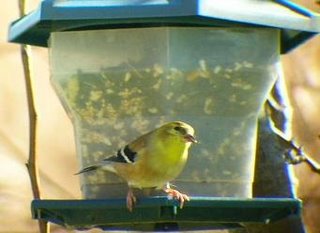
Look at his pretty little pink feet.
This little sparrow stopped in a for a bite:
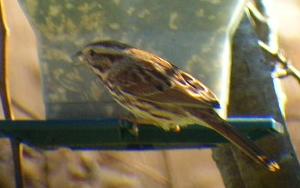 I haven't heard the distinctive song sparrow call since the summertime, so I began to think they'd all flown south. However, after really trying to look at all the details in the photo and in Peterson's, I'm certain this is a song sparrow, though I never got to see his breast to look for the large central spot that Peterson points out. But the streaking on his sides, as well as the lack of white outer tail feathers (vesper sparrow), makes me sure this is a song sparrow. Not to make a big deal of a pretty simple ID, but I'm trying to learn to focus on key ID elements so I don't make as many mistakes with the more difficult IDs.
The sparrow was soon joined by a male house finch:


I tried to zoom in on the house finch to look for conjunctivitis, but if he had it, he had only a minor case. The photos on the Project Feederwatch site all look so severe--but the house finches I saw this morning looked okay. If you can see something I don't see, please let me know, so I can make a correct entry in my Feederwatch weekend report.
The white-breasted nuthatch came back a few times, stopping at both the hanging feeder and the suet block:
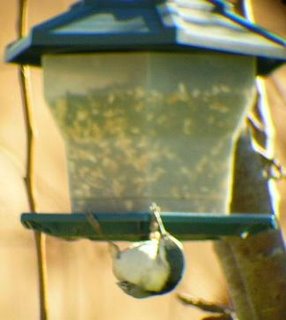 What an acrobat!
That's the extent of the decent photos. I also saw but didn't get even bad photos of the following:
1. some kind of wren, I think. This is the first time I've seen this bird; it was rusty-colored, with a flat tail that reflected sunlight in the most beautiful way. He had the nuthatch's style of creeping close to the tree trunks and fence posts, and he spent a good deal of time perusing the brush piles. Peterson says to look for the tail cocked up over the back, but I didn't see him do that at all. Still, he looked most like a Carolina wren as opposed to a house wren or long-billed marsh wren. I considered his very rusty color and distinctive white eye stripe, plus the lack of striping on the back. Further, Peterson describes this wren as prefering "tangles and brushy undergrowth--he definitely did that. Also he explored a small cavity in a fence post right near one of the brush piles:
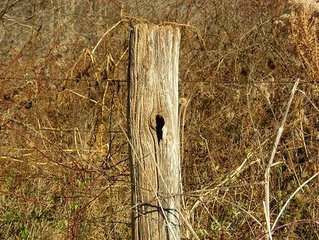 Still, I'm not as certain about this ID, because of the lack of tail-cocking. Everything else, however, tells me it was a Carolina wren.
2. the downy woodpecker, who made his regular appearance at the suet feeder. In Peterson, it seems the only differences between the downy and the hairy are body size and bill length (hairy is bigger with longer beak). One thing Peterson doesn't do in his first edition is show the female downy or hairy; only the males with their red caps near the backs of their heads. However, I've seen a woody with no red spot, larger than the male downy I've seen. I noted a distinct white-and-black pattern (Fig 1 and 2) on her crown and nape (trying to use the right terms here). I thought at first, due to the larger size, that I might have a female hairy. I looked at some other photos and drawings, and I really can't tell which she is. Judging from the fact that she's bigger than the male downy I've seen, I'm going to offer a 50/50 guess that she is a hairy woodpecker. Any help, anyone?
3, 4, 5. several kinds of sparrows. I believe I ID'd white-throated (easy to tell), field (rusty cap, no stickpin marking on breast, no white eyebrow stripe--though I forgot to check color of beak), and swamp (rusty cap, white throat, grayish breast). Wish I had photos of all of them, but most of the time they were on the ground. I need to get that log feeder made so I can get a better view of the ground-feeders.
6. black-capped chickadee. I love their songs and calls.
7. northern mockingbird
8. eastern phoebe, though I only heard this bird--I've heard it a million times but only today did it finally click that the sound was indeed "fee-bee" and it was an eastern phoebe. I'm slow sometimes.
9. a very big raptor, who flew over the marsh a couple of times but never close enough or in good enough light (or rather too much light--he was backlit the whole time by a very bright sun). Peterson offers some silhouettes and views from below, but honestly--all I remember is that it was huge and brown. I've done a lot of work on learning about songbirds, but the raptors have pretty much eluded me, other than the red-tailed hawk whom I can identify pretty easily as long as I see him perched. On this bird, however, I just don't remember the width of the tail, and I didn't see any color other than brown on top and black (from the backlighting) on the bottom.
It was quite a morning overall, and I'm feeling pretty good right now. I'm learning how to take photos through this new scope, which I haven't decided whether I'll keep or not, and I saw two lifebirds. Pretty cool.
The birds, probably just as happy as I was to see the sun, cooperated and took their places at the feeding stations. I set up to watch the platform feeder on the back fence with the scope, later moving it to watch the hanging feeder. I watched the suet feeder with my eyes and my binocs.
My first shot through the scope:
 No, it wasn't night time. This is just that bad. There's a little sparrow in that blackness, sitting on the platform feeder.
Clearly, some adjustment was necessary.
I backed off the zoom on the scope (it goes 20-60X), backed off the zoom on the camera (the Nikon CP4800), and repositioned. Mr. Cardinal allowed this photograph of his somewhat moult-y form:
 Does this fluff make me look fat?
Certainly an improvement, but the focus still wasn't too good. Also, vignetting was a big problem:
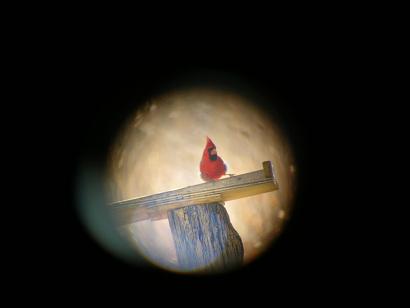 After some experimentation, I found that zooming the scope only a little bit cut the vignetting almost completely for my eye, but it only improved it somewhat for the camera. I think the problem lies in the camera lens, which is set back in the camera body. When I zoom, the barrel comes way out, and it seems the lens is even farther from the scope's eyepiece than before. So the camera was not zoomed at all for the rest of the photos; the scope was mainly on about 25-30X zoom. Further, I have no adapter, so I'm just holding the camera's lens to the scope with my left hand. Conditions were full sun, somewhat backlighting the subjects from directly behind and then slightly to the right but still behind as the sun travelled its in low winter arc across the sky.
I then heard a strange call and was stunned to see my first red-bellied woodpecker! I got a lot of blurry shots, but this is a fairly clear one:

 Of course at first, I was so freaked out by this lifebird that I took a video, but I don't know how to load those onto Blogger and I dare not just try loading it like a photo on my dial-up connection! Let's move on:
 I love the rumps of bluejays--so many shades of blue all together. Bluejays are mean and they tend to hog the feeder, but they're beautiful. At one point when I was just watching through the scope, the red-bellied was sitting on the platform and a jay tried to land, but the red-bellied opened his mouth and shooed the jay away--I didn't really hear a sound from the open mouth, but it was a clear "Hey, wait your turn!"
The infamous American goldfinch in winter plumage showed up and offered this pose:

Look at his pretty little pink feet.
This little sparrow stopped in a for a bite:
 I haven't heard the distinctive song sparrow call since the summertime, so I began to think they'd all flown south. However, after really trying to look at all the details in the photo and in Peterson's, I'm certain this is a song sparrow, though I never got to see his breast to look for the large central spot that Peterson points out. But the streaking on his sides, as well as the lack of white outer tail feathers (vesper sparrow), makes me sure this is a song sparrow. Not to make a big deal of a pretty simple ID, but I'm trying to learn to focus on key ID elements so I don't make as many mistakes with the more difficult IDs.
The sparrow was soon joined by a male house finch:


I tried to zoom in on the house finch to look for conjunctivitis, but if he had it, he had only a minor case. The photos on the Project Feederwatch site all look so severe--but the house finches I saw this morning looked okay. If you can see something I don't see, please let me know, so I can make a correct entry in my Feederwatch weekend report.
The white-breasted nuthatch came back a few times, stopping at both the hanging feeder and the suet block:
 What an acrobat!
That's the extent of the decent photos. I also saw but didn't get even bad photos of the following:
1. some kind of wren, I think. This is the first time I've seen this bird; it was rusty-colored, with a flat tail that reflected sunlight in the most beautiful way. He had the nuthatch's style of creeping close to the tree trunks and fence posts, and he spent a good deal of time perusing the brush piles. Peterson says to look for the tail cocked up over the back, but I didn't see him do that at all. Still, he looked most like a Carolina wren as opposed to a house wren or long-billed marsh wren. I considered his very rusty color and distinctive white eye stripe, plus the lack of striping on the back. Further, Peterson describes this wren as prefering "tangles and brushy undergrowth--he definitely did that. Also he explored a small cavity in a fence post right near one of the brush piles:
 Still, I'm not as certain about this ID, because of the lack of tail-cocking. Everything else, however, tells me it was a Carolina wren.
2. the downy woodpecker, who made his regular appearance at the suet feeder. In Peterson, it seems the only differences between the downy and the hairy are body size and bill length (hairy is bigger with longer beak). One thing Peterson doesn't do in his first edition is show the female downy or hairy; only the males with their red caps near the backs of their heads. However, I've seen a woody with no red spot, larger than the male downy I've seen. I noted a distinct white-and-black pattern (Fig 1 and 2) on her crown and nape (trying to use the right terms here). I thought at first, due to the larger size, that I might have a female hairy. I looked at some other photos and drawings, and I really can't tell which she is. Judging from the fact that she's bigger than the male downy I've seen, I'm going to offer a 50/50 guess that she is a hairy woodpecker. Any help, anyone?
3, 4, 5. several kinds of sparrows. I believe I ID'd white-throated (easy to tell), field (rusty cap, no stickpin marking on breast, no white eyebrow stripe--though I forgot to check color of beak), and swamp (rusty cap, white throat, grayish breast). Wish I had photos of all of them, but most of the time they were on the ground. I need to get that log feeder made so I can get a better view of the ground-feeders.
6. black-capped chickadee. I love their songs and calls.
7. northern mockingbird
8. eastern phoebe, though I only heard this bird--I've heard it a million times but only today did it finally click that the sound was indeed "fee-bee" and it was an eastern phoebe. I'm slow sometimes.
9. a very big raptor, who flew over the marsh a couple of times but never close enough or in good enough light (or rather too much light--he was backlit the whole time by a very bright sun). Peterson offers some silhouettes and views from below, but honestly--all I remember is that it was huge and brown. I've done a lot of work on learning about songbirds, but the raptors have pretty much eluded me, other than the red-tailed hawk whom I can identify pretty easily as long as I see him perched. On this bird, however, I just don't remember the width of the tail, and I didn't see any color other than brown on top and black (from the backlighting) on the bottom.
It was quite a morning overall, and I'm feeling pretty good right now. I'm learning how to take photos through this new scope, which I haven't decided whether I'll keep or not, and I saw two lifebirds. Pretty cool.
Subscribe to:
Posts (Atom)